



NHL Salary Cap Could Reach $150 Million: Financial Implications for Players

The National Hockey League (NHL) financial outlook continues to strengthen, with significant salary cap increases reportedly on the horizon. According to a recent Sportsnet report, the league’s salary cap could reach $150 million in U.S. dollars (USD) by 2029–30, representing a 44% increase from today’s $104 million USD ceiling.
While rising salaries create exciting opportunities, they also reinforce the importance of protecting and managing career earnings.
Summary
The NHL’s rising salary cap could create new earning opportunities for players, particularly those approaching contract negotiations or free agency. However, earning more is only part of the equation. Protecting future earnings, managing currency exposure, and maintaining disciplined cash flow remain critical to translating a successful playing career into lasting financial security.
Key Takeaways
-
- The NHL’s salary cap could reach $150 million by 2029–30, potentially creating significant new earning opportunities for players.
Salary cap increases may particularly benefit players approaching free agency or contract negotiations.
- A reported potential 7% player top-up for 2026–27 could provide additional income, subject to final revenue calculations.
- Disability and life insurance can help protect players and their families against unexpected changes in earning capacity.
- Strategic currency management can help players with cross-border financial obligations reduce conversion costs and manage exchange-rate exposure.
- Disciplined cash flow and careful management of fixed expenses are essential to preserving wealth beyond a playing career.
NHL Salary Cap Outlook
Following several years of relatively flat growth, the NHL’s salary cap has climbed from $88 million in 2024–25 to $104 million in 2026–27, with further increases projected (all figures in USD):
- 2027–28: $113.5 million (NHL/NHLPA announced projection)
- 2028–29: $127.5 million (initial NHL estimate)
- 2029–30: Potentially $150 million (Sportsnet projection)
These increases are supported by league revenues expected to exceed $8 billion in combined Canadian and U.S. currencies this season. Interestingly, it is estimated that the salary cap would be closer to $128 million today based on current revenues. The difference reflects a temporary formula introduced following the pandemic that uses historical revenues to smooth cap increases.
NHL Salary Cap
Actual Cap and Projected Outlook (U.S. Millions)
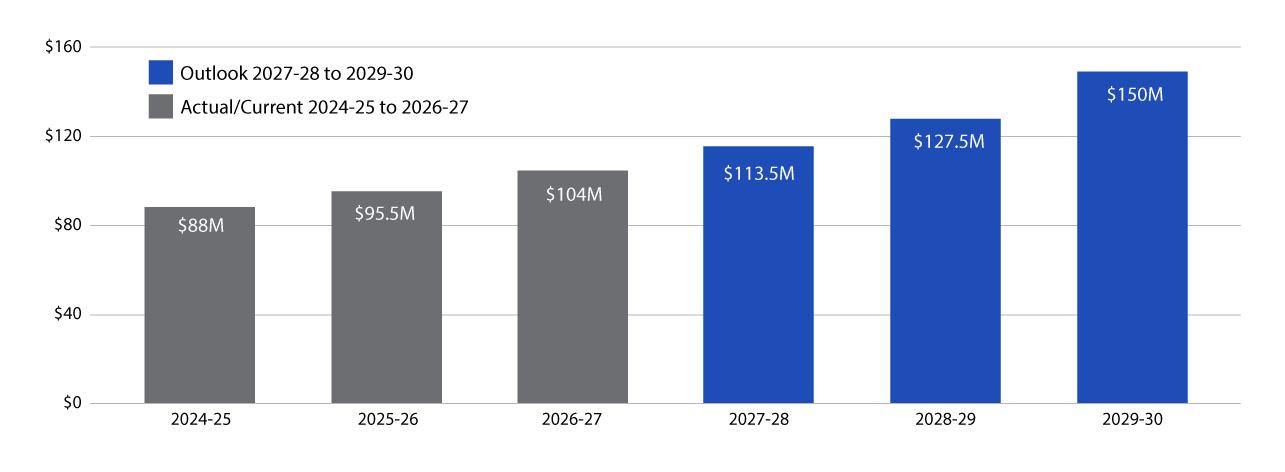
2027-28: NHL/NHLPA announced target //2028-29: Initial NHL estimate // 2029-30: Sportsnet scenario
Sources: NHL/NHLPA; Sportsnet (Frank Seravalli, October 28, 2026). Projections subject to change.
Potential 7% Player Top-Up
With players entitled to 50% of hockey-related revenues under the NHL Collective Bargaining Agreement, reports suggest players are tracking toward an additional payment of approximately 7% of their contracted salaries for 2026–27, subject to final league revenue calculations.
Current projections assume annual revenue growth of approximately 5%, below the historical average of roughly 7%. Stronger revenue growth, potential expansion, and further negotiations between the NHL and the National Hockey League Players’ Association (NHLPA) could push future cap figures even higher.
For players approaching free agency or contract extensions, these developments could significantly influence future earning potential.
Three Financial Planning Considerations for NHL Players
1. Protect Your Biggest Asset: Future Earnings
While this varies by career stage, the greatest financial asset for most professional athletes is their ability to generate income throughout their playing career.
As contracts grow, so do the financial consequences of a career-altering injury or illness. Appropriate disability insurance can help protect future earning potential, while life insurance provides financial security for family members and dependants. Players should regularly review existing coverage and evaluate whether additional protection is warranted as their contracts and financial obligations increase.
2. Manage Currency Exposure
For players earning U.S. dollars with financial commitments in Canada or overseas, currency management remains an important planning consideration.
Despite considerable economic volatility, the Canadian dollar (CAD) has traded within a relatively narrow range for much of the past decade and remained largely range-bound throughout 2026. For players with Canadian-dollar expenses or debt, taking advantage of periods of CAD weakness to strategically convert U.S. dollars is increasingly important.
Conversion costs also matter. Utilizing competitive private foreign exchange (FX) brokers rather than traditional bank conversion rates can often save players thousands of dollars throughout a season.
When significant signing bonuses or future payments are known in advance, hedging strategies can be particularly valuable in managing exchange-rate uncertainty.
These considerations extend beyond Canada, particularly for European players with future obligations in Swedish krona (SEK), Swiss francs (CHF) or euros (EUR). The objective is to minimize conversion costs, manage currency risk, and ensure funds are available in the currencies needed.
3. Control Cash Flow
As salaries rise, one of the most common financial pitfalls is allowing lifestyle expenses to increase at the same pace.
Of particular concern are fixed financial commitments, including multiple residences, substantial mortgages, expensive vehicle leases, and other recurring obligations. Unlike discretionary purchases, these expenses can be difficult to unwind and may continue well beyond a player’s earning years.
Turning Higher Earnings into Long-Term Financial Security
As the NHL’s salary cap continues to rise, players may have new opportunities to strengthen their financial futures. Maintaining disciplined cash flow, planning for contract uncertainty, and evaluating lifestyle commitments against realistic long-term earnings are essential to preserving financial flexibility.
The goal is not to restrict enjoyment during a successful career, but to ensure today’s financial decisions do not compromise tomorrow’s independence.
At Cardinal Point Athlete Advisors, we help professional athletes navigate the financial decisions that arise throughout their careers and beyond. Contact our team to learn more about our approach to financial planning for athletes.
Source: Frank Seravalli, “Where the NHL salary cap could soar to in the next three years,” Sportsnet, October 28, 2026.
Projections and potential top-up payments remain subject to change.


Personal Finance
